




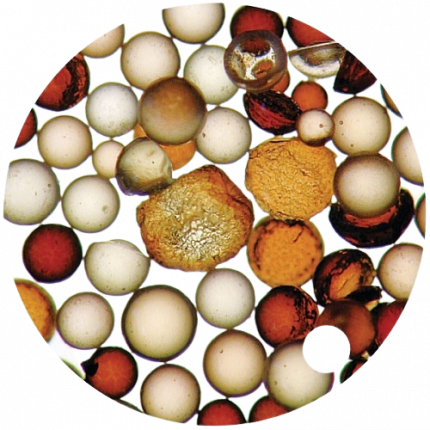
Filter material Ecomix C is a very efficient filter material.
Ecomix C:
- get rid of the scale on plumbing and the scale on heating elements;
- removes the metallic taste of the water;
- reduces the water color and odor.
Main advantages:
- Solving the main water problem in one filter instead of 2-3;
- Stable purified water quality throughout the service life;
- Low salt consumption for regeneration.
Where is it used?
The filter material Ecomix C is used in Ecosoft FK type filters. Ecomix® C is introduced into the filter as a mixture and it is divided into five layers during the first regeneration. Normal tablet salt is used for regeneration.
Filtration systems with Ecomix C are widely used both for domestic purposes and industry.
5 active components of the Ecomix filter material:
1. Inert material – improves backwashing.
2. FerroSorb sorbent reduces iron and manganese content.
The iron content reduction mechanism consists of adsorption (fixation) on the surface of the material, oxidation, active layer formation and autocatalytic oxidation. As a result the content of all the main forms of iron (dissolved, oxidized, organic and colloidal) is reduced.
The best iron and manganese removal efficiency is achieved by applying the well water directly to the Ecomix material.
3. HumiSorb sorbent is designed to reduce permanganate oxidation and the water color.
Organic compounds are separated by the mechanism of electrostatic hydrophobic interaction.
4. Ion exchange resin (cation exchange agent) – softens the water.
In the process of filtering the water through a cation exchange the hardness ions Ca2+ and Mg2+ are replaced by Na+ ions. During regeneration calcium and magnesium ions are flushed down the drain and the cation exchanger is saturated with sodium ions from the brine.
5. Quartz sand is used to evenly distribute the water flow through the filter during its washing.
Regeneration of the Ecomix filter material:
During operation the filter material is periodically regenerated with a saline solution just like conventional ion exchange resins.
— During the brine regeneration stage the calcium and magnesium ions are replaced by sodium ions.
— Iron and manganese compounds are removed by surface friction of the FerroSorb grains during backwashing.
— HumiSorb’s reversible sorption mechanism of organic compounds ensures efficient regeneration.
| Unit: | 12 l/bag |
| Service time: | 5 years |
| Filtering speed: | 20 – 25 m/h |
| Backwash speed: | 10–15 m/h |
| Brine flushing speed: | 3–5 m/h |
| Minimum layer height: | 500 mm |
| Optimal layer height: | 800 mm |
| Maximum working temperature: | 40 °С |
| Salt consumption: | 100 g/l |
Requirements for supplied water:
| Hardness: | 15 meq/l |
| Iron: | 15 mg/l |
| Manganese: | 3 mg/l |
| Chemical oxygen demand: | 20 mg O₂/L |
| Ammonium: | 4 mg/l |
| pH: | 5 – 9 |
| Maximum TDS: | 4000 mg/l |




Reviews
There are no reviews yet.