




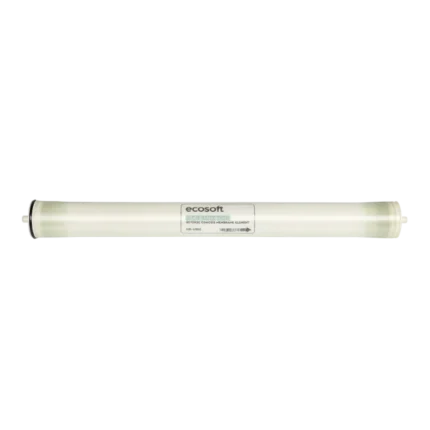

- Permeate flow rate up to 10.2 m³/day
- High permeate flow at extremely low operating pressure
- Efficient performance with reduced operating costs
- Recommended feed water TDS up to 1500 mg/l
- Designed for commercial reverse osmosis systems
- Suitable for drinking water supply, food industry, farms and greenhouses
Specification
Permeate flow rate* – 10.2 m³/day
Minimum salt rejection** – 97.5%
Stabilized salt rejection** – 98.0%
Nominal active area – 7.9 m²
Operating pressure – 6.9 bar
Feed liner thickness – 34 mm
Maximum operating water temperature – 45°C
Maximum operating pressure – 41.0 bar
Maximum pressure drop – 1.0 bar
pH range, operating mode – 3-10
pH range, dry cleaning mode – 2-12
Maximum feed flow – 3.6 m³/h
Maximum feed sludge density index – SDI 5
Free chlorine tolerance – <0.1 ppm
* Permeate flow of a single element may vary by ±15% from the specified value.
** Permeate flux and salt rejection are based on standard test conditions: 500 mg/L NaCl, 25°C, 15% permeate yield and 6.9 bar applied pressure.
Product specifications may be subject to slight changes due to product improvements.
Source water requirements
Specification
Maximum operating water temperature – 45°C
pH range, operating mode – 3-10
pH range, dry cleaning mode – 2-12
Maximum feed sludge density index – SDI 5
Free chlorine tolerance – <0.1 ppm
Before start-up, ensure that the membrane is properly prepared for operation. Check membrane pretreatment, membrane element installation, instrument calibration and overall system condition.
During start-up, shut-down, cleaning and other maintenance procedures, avoid large pressure surges and flow fluctuations inside the spiral elements, as they can damage the membrane.
During start-up, it is recommended to gradually switch the system from idle to operating mode by performing the following steps:
Gradually increase the feed water pressure over 30-60 seconds,
Gradually restore the system operating flow over 15-20 seconds,
The permeate produced during the first hour of operation must be drained.
After the initial wetting, the membrane must be wet.
To prevent biofouling during prolonged downtime, store the membrane elements in a preservative solution. The pressure drop across the entire length of the housing must not exceed 3.4 bar.




Reviews
There are no reviews yet.