

Water is one of the determining factors of a high quality of life. Most often it is supplied to users from the centralized water supply systems or from the underground wells.
Tap water can have a specific smell, a yellowish tint as well as an increased content of hardness salts (less often also iron, aluminum and nitrates). Well water, on the other hand, is characterized by increased hardness and iron content in it as well as an increased level of hydrogen sulfide (the smell of rotten eggs).
Therefore, both tap water and well water require some purification to be clean and safe for consumption.
How dangerous is raw water?
The diagram shows the most typical pollutants to different types of water.

In addition, pollutants as heavy metal ions, nitrates, pesticides, phenols and other dangerous substances are also common.
If the water is taken from the centralized water supply system, the main causes of its contamination are:
- outdated water treatment equipment that does not cope with the tasks assigned to it;
- chlorine smell due to excessive chlorination;
- the general condition of the water sources and the amount of pollutants in them.
Well water, on the other hand, is characterized by a red and/or gray coating on the plumbing as well as a metallic taste due to the high iron and manganese content. Water can have a rotten egg smell due to high hydrogen sulfide content. Sand and clay rocks can cause high water turbidity.
Therefore, before choosing a filter for water purification, it is recommended to conduct water analyzes first and consult with a specialist about the most appropriate solution for you.
Types of water filters
Nowadays there is available a very wide range of the water treatment equipment. You can choose water filters suitable for both private houses and apartments. The wide assortment allows you to provide clean and safe water in your house according to your financial capabilities.
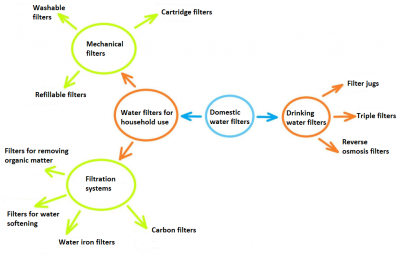
The diagram shows the classification of domestic water filters.
How to choose a drinking water filter?
There are three types of drinking water purification systems: filter jugs, triple filters and reverse osmosis filters.

-
JUG FILTER
A jug filter (also called cup filter) is the simplest water purification device. It is made of plastic. Inside the filter there is installed the cartridge through which water passes during the filtering process. The cartridge is filled with a mixture of different cleaning components (usually activated carbon, ion exchange resin) that protects against:
- scale deposits on the kettle (removes hardness salt ions);
- unpleasant odors (removes chlorine and its carcinogenic compounds);
- water color (removes organic impurities);
- metallic taste of the water (removes iron);
- water turbidity (removes mechanical impurities);
- jug filters can also reduce heavy metals and toxic organic compounds.
Such filter maintenance includes replacing the cartridge element once a month. The replacement frequency may vary depending on the water quantity and quality.
-
TRIPLE WATER FILTER
The triple water filter consists of three plastic flasks with replaceable cartridges attached to a durable plastic frame. The filter is connected to the cold water supply line and installed under the sink. A faucet for purified water is located on the surface of the sink.
Inside the filter there are three sets of cartridges for removing different types of pollutants. Such filters have three stages of purification:
- mechanical filtration, during which sand, rust, scale and other impurities larger than 5 microns are removed;
- water softening and removal of iron and manganese ions on ion exchange cartridges;
- sorption of chlorine and chlorination products, organic toxic and malodorous compounds from the water.
A triple water filter is an excellent choice for tap water. Standard cartridge sets are designed for medium quality water. Filter maintenance consists of replacing the cartridge elements and washing the flasks once a quarter. This filter can be installed both independently and with the help of a qualified specialist.
-
REVERSE OSMOSIS FILTER
Reverse osmosis (RO) is the most advanced and universal solution to ensure clean and safe drinking water. RO filters can purify almost any water. The filter membrane removes up to 99.8% of contaminants, including the smallest virus particles.
The RO water filter provides pre-cleaning in the form of a set of three cartridge filters that facilitate the operation of the membrane:
- a cartridge made of foamed polypropylene with a filtration degree of 5 microns removes mechanical impurities (sand, rust, sludge, etc.);
- a cartridge made of granulated activated carbon removes chlorine, organochlorine and organic impurities;
- the carbon block removes chlorine residues and mechanical impurities.
The main element of the reverse osmosis water filter is the membrane which ensures water purification from all possible impurities. Reverse osmosis water does not require sterilization and can be consumed even by children without boiling. To ensure a constant supply of clean drinking water, RO water filters are additionally equipped with a water storage tank.
Maintenance of reverse osmosis filters consists of replacing the pre-cleaning cartridges every 3-6 months, replacing the post-filter every 6 months and replacing the membrane element once a year. Filter maintenance is recommended to be performed by a qualified specialist.
WATER MINERALIZATION
After membrane purification the water can be delivered to the final consumer, but since the water is completely desalinated during the purification process, it is recommended to add minerals (calcium and magnesium) to the water. Special mineralizing filters are available for this purpose which enrich the water with the necessary amount of macroelement ions.
DISINFECTION OF WATER USING UV LAMPS
Water that has undergone membrane purification has no impurities. However, when treated water is in a storage tank for a long time, microorganisms can develop in it. Water disinfectants such as UV lamps are used to prevent the development of microorganisms. The principle of operation of such devices is based on the effect of UV rays, destroying pathogenic microorganisms and preventing them from multiplying.
How to choose a filter for household water purification?
The possibilities of water purification for household needs are wide. The most commonly used are:
- mechanical filters (cartridge, washable, refillable);
- water softening filters;
- water de-ironing filters;
- carbon filters (remove chlorine, organic substances and hydrogen sulphide).
MECHANICAL FILTERS
Mechanical water impurities are particles of sand, clay, silt, rust and other insoluble elements. These particles are in a suspended state in the water. Using such water for a long time significantly shortens the service life of household appliances, plumbing as well as installed drinking water purification systems.
Thanks to mechanical filters:
- the resource of filtering stages is increased;
- plumbing and piping elements last longer;
- deposits in the bathroom and sink disappears.
When choosing the type of mechanical filter factors such as the amount of insoluble impurities, water consumption as well as the area that can be allocated for the installation of filtration equipment must be taken into account.
1. CARTRIDGE FILTERS FOR WATER
A cartridge water filter is the simplest and most common type of mechanical water filter. Its main components are the filter flask (body) and the replaceable cartridge.

The filter is connected to the cold water supply of the house. During the filtration process water flows into the cartridge which removes impurities. The degree of purification is characterized by the size of the retained particles which is called the degree of filtration. The most typical filtration degrees for cartridge filters are 20, 10, 5 and 1 μm.
For example: a filter with a filtration degree of 5 microns removes all particles of mechanical impurities with a size of 5 microns and larger.
Filter flasks are made of high quality, high pressure and sometimes heat resistant plastic.
ADVANTAGES:
- simple installation and maintenance, it can be done even without the involvement of a specialist;
- high quality of Ecosoft products which is confirmed by product certification;
- low start-up costs.
DISADVANTAGES:
Filter element replacement costs.
2. WASHABLE WATER FILTERS
The principle of operation of washable water filters is similar to the cartridge filter, however, in the case of washable water filters impurities are not retained in the replaceable cartridge but in the cylindrical metal grid. When the grid is clogged, it is flushed with a stream of water through a separate outlet. Sometimes the filter parts need to be washed manually.
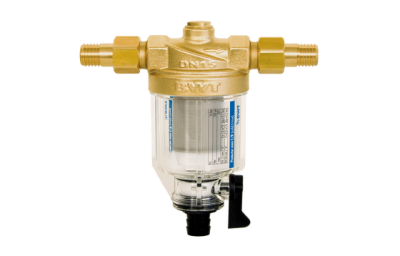
This type of filters are made for both cold and hot water. The filter body is mainly made of brass which is resistant to water and its impurities.
ADVANTAGES:
- quick and easy installation and maintenance;
- no need to change cartridges;
- compact size.
DISADVANTAGES:
Relatively high initial costs.
3. REFILLABLE FILTERS
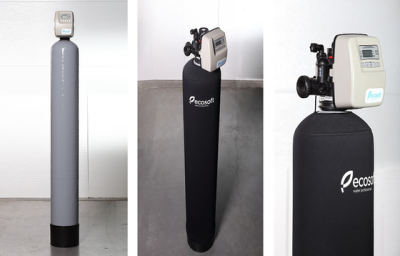
The refillable column type filter is perfect for turbid well water. They are characterized by a polymer corrosion-resistant housing with an automatic water supply valve. The column is filled with filter material.
The main characteristics of the filter material:
- high mechanical resistance to wear;
- chemical inertness to avoid water contamination with additional impurities.
During the filtration process particles of the filter material in the water hold impurities. Automatic filter regeneration occurs when the filter resource runs out. Due to automation these processes do not require human intervention and regeneration is carried out during minimal water consumption.
The choice of a mechanical filter for water purification depends on the set goals and the required performance of the home water purification system.
Water hardness
Water hardness is associated with calcium (Ca 2+) and magnesium (Mg 2+) cations. These are the main cations that forms hardness salts. Although other cations also affect water hardness, their contribution is so small that they are not taken into account. Divalent metal cations interact with anions and form compounds that cause sediments. On the other hand, univalent cations (e.g. sodium Na + cations) do not form deposits.
The table shows the main components of water hardness:
| Cations | Anions |
| Calcium (Ca 2+) | Bicarbonates (HCO 3 -) |
| Magnesium (Mg 2+) | Sulfates (SO 4 2-) |
| Iron (Fe 2+) | Chlorides (Cl-) |
| Manganese (Mn 2+) | Silicates (SiO 3 2-) |
Cations are positively charged particles (usually metal particles) while anions are negatively charged (usually complex non-metallic compounds).
The main disadvantages of hard water::
- skin and hair discomfort (dryness, irritation);
- reduces work efficiency, causes damage to electrical devices, reduces the heat output of heating systems and causes excessive energy consumption;
- soap and washing powder are less soluble in hard water so they are used excessively during the washing.
WATER SOFTENING METHODS
There are three methods of water softening:
- ion exchange;
- introduction of reagents;
- equipment without reagents.
-
Ion exchange
The principle of ion exchange is based on the properties of synthetic polymer resins. They are granules that contain specific ion exchange groups on their surface. They can attach metal cations to themselves and exchange them, for example, ions from the resin surface for ions from water.
The principle of operation of household cationites is that the ion exchange resin contains sodium ions on its surface. When hard water passes through the layer of ion exchange resin, these sodium ions are detached from the surface and replaced by the basic ions of hardness — calcium and magnesium. As a result, we get water that contains sodium salts, which are not capable of forming plaque and scale, instead of calcium and magnesium bicarbonates, which are the source of scale on heaters and white streaks on plumbing. In order to restore the resource of ion exchange resins, their regeneration takes place – automatic washing with sodium chloride solution.
Some ion exchange resins or their mixtures are capable of removing not only hardness ions but also have high selectivity for iron ions and other impurities. Filters with such fillings are called complex cleaning systems.
How does an ion exchange filter work?

The filter is installed at the cold water supply. Water, previously purified from mechanical impurities, enters the filter housing, which is filled with filter material and, passing through the resin layer, is cleaned of hardness salts. Purified water is supplied to the consumer or to subsequent stages of purification through the central pipe of the housing.
When the resin resource no longer absorb hardness ions, the control valve switches the filter to regeneration mode. For the convenience of the consumer, the valve settings are programmed so that the filter is regenerated during minimum water consumption.
-
Water softening using reagents
The reagent method involves the addition of specific, safe chemicals (antiscalants) to the water which forms compounds with hardness salts and does not form scale deposits. Such filters are enough for approximately 6 months of boiler or washing machine operation.
-
Reagent-free technologies
In the case of reagent-free technologies the effect of specific factors on water, such as a magnetic field or nanocrystallization, is ensured. BWT AQA NANO systems use an electric field that causes nanocrystals to form in water with a negative charge, so they cannot “settle on the surface”. Such systems are good because they do not require flushing, salt and replacement of replaceable cartridges.
WATER PURIFICATION USING ADSORPTION METHOD
Adsorption is a process in which individual pollutants are concentrated on the surface of the pores of special substances (sorbents).
Adsorption filters are designed to purify water from:
- chlorine and organochlorine compounds;
- natural (fulvic acids) and man-made organic compounds (pesticides, phenols).
Water purification technologies use combustion products of natural raw materials such as wood, seeds of various fruits etc. Specially processed or activated carbon is the most common and most effective sorbent for water purification from chlorine, toxic organic substances of natural and industrial origin. Sometimes during the production process, additional impurities (e.g. silver particles) are added to the material which makes the coal resistant to biological contamination.

In order to install water adsorption filters, expert consultation and water analyzes are required to determine the degree of purification, the weight of the filter material, the initial stages of purification, etc.
Hydrogen sulfide and iron in water
Hydrogen sulfide and iron are the main problems with well water. It is a fact that when the well water settles, the iron is deposited in it and the hydrogen sulfide disappears. This happens because of the oxygen which ensures the oxidation of the mentioned compounds. Cartridge and refillable filters have a similar principle: thanks to the special surface structure they accelerate the oxidation process and provide clean water that is tasteless and odorless.
Complex water treatment for homes
Filters with Ecomix material combine several devices in one. Thanks to the properties of the ion exchange materials in the system they are able to reduce the content of hardness salts, iron, manganese as well as ammonia and natural organic substances. Working and regeneration process is the same as in the ion exchange filters.

How to choose a water filter?
In order to choose the water treatment equipment the following aspects should be evaluated:
- Where is the water supplied from (well or the centralized water supply system)? Depending on the source of the water certain problems are inherent in the water.
- What water problems are observed (color, odor, sediment)?
- Is it necessary to carry out water analysis and is a specialist’s consultation required?
- What kind of water needs to be purified (drinking, technical, heating system or boiler water, etc.)?
- Where the filter will be placed?
After analyzing all mentioned aspects, it is possible to make a decision about installing the most appropriate water treatment system.
Read also: What does the water analysis say?